

It is not easy to feel an overwhelming sense of gratitude and thanksgiving when you’re going through a trial. Many years ago, I pleaded for God to resurrect my dead marriage. I prayed each day, repeatedly asking for the same thing.
Then, early one morning, just as I began to open my mouth to pray, the Lord spoke to my heart and said, “Come, not asking anything, but praise.”
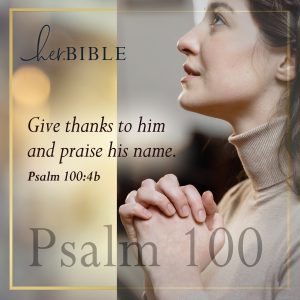
The words halted me and shifted my focus from asking God to do what I wanted Him to do to praising Him for what He had already done. It takes quietness before God and reflecting on what He has already done for gratitude to spring forth from the depths of your heart.
Giving thanks empowers us to overcome anything that comes our way. Life can be challenging, but God is always good. And if we look hard enough, we will see His goodness.
There is always a reason to give God praise, but we need our eyes to be opened to see God’s blessings all around us. Before long, I experienced a miracle in my marriage.
In your own painful places, I urge you to look to Psalm 100 for guidance. It is a Psalm of thanksgiving. It offers us a picture of a heart attitude approaching God in prayer.
First, we are to worship the Lord with gladness and come before him singing with joy (v. 2). Secondly, we are to enter his gates with thanksgiving and go into his courts with praise. Give thanks to him and praise his name (v.4). Why? Because the Lord is good. His unfailing love continues forever, and his faithfulness continues to each generation (v.5).
Thanksgiving and praise have less to do with our hardships and more to do with our faith.
Approaching God with a thankful heart is giving Him what He truly deserves.
*For deeper reflection, listen to Psalm 100.
-
Genesis 1
-:--
/
-:--
-
1 In the beginning God created the heavens and the earth.a 2 The earth was formless and empty, and darkness covered the deep waters. And the Spirit of God was hovering over the surface of the waters.
3 Then God said, “Let there be light,” and there was light. 4 And God saw that the light was good. Then he separated the light from the darkness. 5 God called the light “day” and the darkness “night.”
And evening passed and morning came, marking the first day.
6 Then God said, “Let there be a space between the waters, to separate the waters of the heavens from the waters of the earth.” 7 And that is what happened. God made this space to separate the waters of the earth from the waters of the heavens. 8 God called the space “sky.”
And evening passed and morning came, marking the second day.
9 Then God said, “Let the waters beneath the sky flow together into one place, so dry ground may appear.” And that is what happened. 10 God called the dry ground “land” and the waters “seas.” And God saw that it was good. 11 Then God said, “Let the land sprout with vegetation—every sort of seed-bearing plant, and trees that grow seed-bearing fruit. These seeds will then produce the kinds of plants and trees from which they came.” And that is what happened. 12 The land produced vegetation—all sorts of seed-bearing plants, and trees with seed-bearing fruit. Their seeds produced plants and trees of the same kind. And God saw that it was good.
13 And evening passed and morning came, marking the third day.
14 Then God said, “Let lights appear in the sky to separate the day from the night. Let them be signs to mark the seasons, days, and years. 15 Let these lights in the sky shine down on the earth.” And that is what happened. 16 God made two great lights—the larger one to govern the day, and the smaller one to govern the night. He also made the stars. 17 God set these lights in the sky to light the earth, 18 to govern the day and night, and to separate the light from the darkness. And God saw that it was good.
19 And evening passed and morning came, marking the fourth day.
20 Then God said, “Let the waters swarm with fish and other life. Let the skies be filled with birds of every kind.” 21 So God created great sea creatures and every living thing that scurries and swarms in the water, and every sort of bird—each producing offspring of the same kind. And God saw that it was good. 22 Then God blessed them, saying, “Be fruitful and multiply. Let the fish fill the seas, and let the birds multiply on the earth.”
23 And evening passed and morning came, marking the fifth day.24 Then God said, “Let the earth produce every sort of animal, each producing offspring of the same kind—livestock, small animals that scurry along the ground, and wild animals.” And that is what happened. 25 God made all sorts of wild animals, livestock, and small animals, each able to produce offspring of the same kind. And God saw that it was good.
26 Then God said, “Let us make human beingsb in our image, to be like us. They will reign over the fish in the sea, the birds in the sky, the livestock, all the wild animals on the earth,c and the small animals that scurry along the ground.”
27 So God created human beingsd in his own image.
In the image of God he created them;
male and female he created them.28 Then God blessed them and said, “Be fruitful and multiply. Fill the earth and govern it. Reign over the fish in the sea, the birds in the sky, and all the animals that scurry along the ground.”
29 Then God said, “Look! I have given you every seed-bearing plant throughout the earth and all the fruit trees for your food. 30 And I have given every green plant as food for all the wild animals, the birds in the sky, and the small animals that scurry along the ground—everything that has life.” And that is what happened.
31 Then God looked over all he had made, and he saw that it was very good!
And evening passed and morning came, marking the sixth day.
a. 1:1 Or In the beginning when God created the heavens and the earth, . . . Or When God began to create the heavens and the earth, . . .
b. 1:26a Or man; Hebrew reads adam.
c. 1:26b As in Syriac version; Hebrew reads all the earth.
d. 1:27 Or the man; Hebrew reads ha-adam. -
Leviticus 5
-:--
/
-:--
-
1 “If you are called to testify about something you have seen or that you know about, it is sinful to refuse to testify, and you will be punished for your sin.
2 “Or suppose you unknowingly touch something that is ceremonially unclean, such as the carcass of an unclean animal. When you realize what you have done, you must admit your defilement and your guilt. This is true whether it is a wild animal, a domestic animal, or an animal that scurries along the ground.
3 “Or suppose you unknowingly touch something that makes a person unclean. When you realize what you have done, you must admit your guilt.
4 “Or suppose you make a foolish vow of any kind, whether its purpose is for good or for bad. When you realize its foolishness, you must admit your guilt.
5 “When you become aware of your guilt in any of these ways, you must confess your sin. 6 Then you must bring to the Lord as the penalty for your sin a female from the flock, either a sheep or a goat. This is a sin offering with which the priest will purify you from your sin, making you right with the Lord.a
7 “But if you cannot afford to bring a sheep, you may bring to the Lord two turtledoves or two young pigeons as the penalty for your sin. One of the birds will be for a sin offering, and the other for a burnt offering. 8 You must bring them to the priest, who will present the first bird as the sin offering. He will wring its neck but without severing its head from the body. 9 Then he will sprinkle some of the blood of the sin offering against the sides of the altar, and the rest of the blood will be drained out at the base of the altar. This is an offering for sin. 10 The priest will then prepare the second bird as a burnt offering, following all the procedures that have been prescribed. Through this process the priest will purify you from your sin, making you right with the Lord, and you will be forgiven.
11 “If you cannot afford to bring two turtledoves or two young pigeons, you may bring two quartsb of choice flour for your sin offering. Since it is an offering for sin, you must not moisten it with olive oil or put any frankincense on it. 12 Take the flour to the priest, who will scoop out a handful as a representative portion. He will burn it on the altar on top of the special gifts presented to the Lord. It is an offering for sin. 13 Through this process, the priest will purify those who are guilty of any of these sins, making them right with the Lord, and they will be forgiven. The rest of the flour will belong to the priest, just as with the grain offering.”
14 Then the Lord said to Moses, 15 “If one of you commits a sin by unintentionally defiling the Lord’s sacred property, you must bring a guilt offering to the Lord. The offering must be your own ram with no defects, or you may buy one of equal value with silver, as measured by the weight of the sanctuary shekel.c 16 You must make restitution for the sacred property you have harmed by paying for the loss, plus an additional 20 percent. When you give the payment to the priest, he will purify you with the ram sacrificed as a guilt offering, making you right with the Lord, and you will be forgiven.
17 “Suppose you sin by violating one of the Lord’s commands. Even if you are unaware of what you have done, you are guilty and will be punished for your sin. 18 For a guilt offering, you must bring to the priest your own ram with no defects, or you may buy one of equal value. Through this process the priest will purify you from your unintentional sin, making you right with the Lord, and you will be forgiven. 19 This is a guilt offering, for you have been guilty of an offense against the Lord.”
a. 5:6 Or will make atonement for you for your sin; similarly in 5:10, 13, 16, 18.
b. 5:11 Hebrew 1/10 of an ephah [2.2 liters].
c. 5:15 Each shekel was about 0.4 ounces or 11 grams in weight. -
Joshua 2
-:--
/
-:--
-
1 Then Joshua secretly sent out two spies from the Israelite camp at Acacia Grove.a He instructed them, “Scout out the land on the other side of the Jordan River, especially around Jericho.” So the two men set out and came to the house of a prostitute named Rahab and stayed there that night.
2 But someone told the king of Jericho, “Some Israelites have come here tonight to spy out the land.” 3 So the king of Jericho sent orders to Rahab: “Bring out the men who have come into your house, for they have come here to spy out the whole land.”
4 Rahab had hidden the two men, but she replied, “Yes, the men were here earlier, but I didn’t know where they were from. 5 They left the town at dusk, as the gates were about to close. I don’t know where they went. If you hurry, you can probably catch up with them.” 6 (Actually, she had taken them up to the roof and hidden them beneath bundles of flax she had laid out.) 7 So the king’s men went looking for the spies along the road leading to the shallow crossings of the Jordan River. And as soon as the king’s men had left, the gate of Jericho was shut.
8 Before the spies went to sleep that night, Rahab went up on the roof to talk with them. 9 “I know the Lord has given you this land,” she told them. “We are all afraid of you. Everyone in the land is living in terror. 10 For we have heard how the Lord made a dry path for you through the Red Seab when you left Egypt. And we know what you did to Sihon and Og, the two Amorite kings east of the Jordan River, whose people you completely destroyed.c 11 No wonder our hearts have melted in fear! No one has the courage to fight after hearing such things. For the Lord your God is the supreme God of the heavens above and the earth below.
12 “Now swear to me by the Lord that you will be kind to me and my family since I have helped you. Give me some guarantee that 13 when Jericho is conquered, you will let me live, along with my father and mother, my brothers and sisters, and all their families.”
14 “We offer our own lives as a guarantee for your safety,” the men agreed. “If you don’t betray us, we will keep our promise and be kind to you when the Lord gives us the land.”
15 Then, since Rahab’s house was built into the town wall, she let them down by a rope through the window. 16 “Escape to the hill country,” she told them. “Hide there for three days from the men searching for you. Then, when they have returned, you can go on your way.”
17 Before they left, the men told her, “We will be bound by the oath we have taken only if you follow these instructions. 18 When we come into the land, you must leave this scarlet rope hanging from the window through which you let us down. And all your family members—your father, mother, brothers, and all your relatives—must be here inside the house. 19 If they go out into the street and are killed, it will not be our fault. But if anyone lays a hand on people inside this house, we will accept the responsibility for their death. 20 If you betray us, however, we are not bound by this oath in any way.”
21 “I accept your terms,” she replied. And she sent them on their way, leaving the scarlet rope hanging from the window.
22 The spies went up into the hill country and stayed there three days. The men who were chasing them searched everywhere along the road, but they finally returned without success.
23 Then the two spies came down from the hill country, crossed the Jordan River, and reported to Joshua all that had happened to them. 24 “The Lord has given us the whole land,” they said, “for all the people in the land are terrified of us.”
a. 2:1 Hebrew Shittim.
b. 2:10a Hebrew sea of reeds.
c. 2:10b The Hebrew term used here refers to the complete consecration of things or people to the Lord, either by destroying them or by giving them as an offering.
Lorem ipsum dolor sit amet, consectetur adipiscing elit. Proin nec nulla euismod, condimentum erat et, tincidunt eros. Nam vitae urna nulla. Sed sit amet mauris felis. Fusce nec nulla malesuada, mollis purus aliquet, luctus eros. Proin consequat odio ut quam mattis gravida. Duis sit amet vulputate risus. Morbi efficitur tristique sem, bibendum vehicula nibh imperdiet et. Nam in fringilla urna, et auctor diam. Suspendisse efficitur risus tortor, blandit ornare mi faucibus vitae. Mauris faucibus neque nunc, et mollis justo pharetra quis. Aenean ultrices justo ac enim condimentum, non mattis sem sollicitudin. Phasellus finibus elit at lorem venenatis, ac vehicula ex interdum.
-
1 Kings 11
-:--
/
-:--
-
1 Now King Solomon loved many foreign women. Besides Pharaoh’s daughter, he married women from Moab, Ammon, Edom, Sidon, and from among the Hittites. 2 The Lord had clearly instructed the people of Israel, “You must not marry them, because they will turn your hearts to their gods.” Yet Solomon insisted on loving them anyway. 3 He had 700 wives of royal birth and 300 concubines. And in fact, they did turn his heart away from the Lord.
4 In Solomon’s old age, they turned his heart to worship other gods instead of being completely faithful to the Lord his God, as his father, David, had been. 5 Solomon worshiped Ashtoreth, the goddess of the Sidonians, and Molech,a the detestable god of the Ammonites. 6 In this way, Solomon did what was evil in the Lord’s sight; he refused to follow the Lord completely, as his father, David, had done.
7 On the Mount of Olives, east of Jerusalem,b he even built a pagan shrine for Chemosh, the detestable god of Moab, and another for Molech, the detestable god of the Ammonites. 8 Solomon built such shrines for all his foreign wives to use for burning incense and sacrificing to their gods.
9 The Lord was very angry with Solomon, for his heart had turned away from the Lord, the God of Israel, who had appeared to him twice. 10 He had warned Solomon specifically about worshiping other gods, but Solomon did not listen to the Lord’s command. 11 So now the Lord said to him, “Since you have not kept my covenant and have disobeyed my decrees, I will surely tear the kingdom away from you and give it to one of your servants. 12 But for the sake of your father, David, I will not do this while you are still alive. I will take the kingdom away from your son. 13 And even so, I will not take away the entire kingdom; I will let him be king of one tribe, for the sake of my servant David and for the sake of Jerusalem, my chosen city.”
14 Then the Lord raised up Hadad the Edomite, a member of Edom’s royal family, to be Solomon’s adversary. 15 Years before, David had defeated Edom. Joab, his army commander, had stayed to bury some of the Israelite soldiers who had died in battle. While there, they killed every male in Edom. 16 Joab and the army of Israel had stayed there for six months, killing them.
17 But Hadad and a few of his father’s royal officials escaped and headed for Egypt. (Hadad was just a boy at the time.) 18 They set out from Midian and went to Paran, where others joined them. Then they traveled to Egypt and went to Pharaoh, who gave them a home, food, and some land. 19 Pharaoh grew very fond of Hadad, and he gave him his wife’s sister in marriage—the sister of Queen Tahpenes. 20 She bore him a son named Genubath. Tahpenes raised himc in Pharaoh’s palace among Pharaoh’s own sons.
21 When the news reached Hadad in Egypt that David and his commander Joab were both dead, he said to Pharaoh, “Let me return to my own country.”
22 “Why?” Pharaoh asked him. “What do you lack here that makes you want to go home?”
“Nothing,” he replied. “But even so, please let me return home.”
23 God also raised up Rezon son of Eliada as Solomon’s adversary. Rezon had fled from his master, King Hadadezer of Zobah, 24 and had become the leader of a gang of rebels. After David conquered Hadadezer, Rezon and his men fled to Damascus, where he became king. 25 Rezon was Israel’s bitter adversary for the rest of Solomon’s reign, and he made trouble, just as Hadad did. Rezon hated Israel intensely and continued to reign in Aram.
26 Another rebel leader was Jeroboam son of Nebat, one of Solomon’s own officials. He came from the town of Zeredah in Ephraim, and his mother was Zeruah, a widow.
27 This is the story behind his rebellion. Solomon was rebuilding the supporting terracesd and repairing the walls of the city of his father, David. 28 Jeroboam was a very capable young man, and when Solomon saw how industrious he was, he put him in charge of the labor force from the tribes of Ephraim and Manasseh, the descendants of Joseph.
29 One day as Jeroboam was leaving Jerusalem, the prophet Ahijah from Shiloh met him along the way. Ahijah was wearing a new cloak. The two of them were alone in a field, 30 and Ahijah took hold of the new cloak he was wearing and tore it into twelve pieces. 31 Then he said to Jeroboam, “Take ten of these pieces, for this is what the Lord, the God of Israel, says: ‘I am about to tear the kingdom from the hand of Solomon, and I will give ten of the tribes to you! 32 But I will leave him one tribe for the sake of my servant David and for the sake of Jerusalem, which I have chosen out of all the tribes of Israel. 33 For Solomon hase abandoned me and worshiped Ashtoreth, the goddess of the Sidonians; Chemosh, the god of Moab; and Molech, the god of the Ammonites. He has not followed my ways and done what is pleasing in my sight. He has not obeyed my decrees and regulations as David his father did.
34 “‘But I will not take the entire kingdom from Solomon at this time. For the sake of my servant David, the one whom I chose and who obeyed my commands and decrees, I will keep Solomon as leader for the rest of his life. 35 But I will take the kingdom away from his son and give ten of the tribes to you. 36 His son will have one tribe so that the descendants of David my servant will continue to reign, shining like a lamp in Jerusalem, the city I have chosen to be the place for my name. 37 And I will place you on the throne of Israel, and you will rule over all that your heart desires. 38 If you listen to what I tell you and follow my ways and do whatever I consider to be right, and if you obey my decrees and commands, as my servant David did, then I will always be with you. I will establish an enduring dynasty for you as I did for David, and I will give Israel to you. 39 Because of Solomon’s sin I will punish the descendants of David—though not forever.’”
40 Solomon tried to kill Jeroboam, but he fled to King Shishak of Egypt and stayed there until Solomon died.
41 The rest of the events in Solomon’s reign, including all his deeds and his wisdom, are recorded in The Book of the Acts of Solomon. 42 Solomon ruled in Jerusalem over all Israel for forty years. 43 When he died, he was buried in the City of David, named for his father. Then his son Rehoboam became the next king.
a. 11:5 Hebrew Milcom, a variant spelling of Molech; also in 11:33.
b. 11:7 Hebrew On the mountain east of Jerusalem.
c. 11:20 As in Greek version; Hebrew reads weaned him.
d. 11:27 Hebrew the millo. The meaning of the Hebrew is uncertain.
e. 11:33 As in Greek, Syriac, and Latin Vulgate; Hebrew reads For they have.
Nam diam ante, sagittis non dui et, commodo rutrum sapien. Sed eget fringilla urna, ut sodales lectus. Morbi consequat mattis nibh at varius. Etiam sed faucibus nisi.
-
Exodus 3
-:--
/
-:--
-
1 One day Moses was tending the flock of his father-in-law, Jethro,a the priest of Midian. He led the flock far into the wilderness and came to Sinai,b the mountain of God. 2 There the angel of the Lord appeared to him in a blazing fire from the middle of a bush. Moses stared in amazement. Though the bush was engulfed in flames, it didn’t burn up. 3 “This is amazing,” Moses said to himself. “Why isn’t that bush burning up? I must go see it.”
4 When the Lord saw Moses coming to take a closer look, God called to him from the middle of the bush, “Moses! Moses!”
“Here I am!” Moses replied.
5 “Do not come any closer,” the Lord warned. “Take off your sandals, for you are standing on holy ground. 6 I am the God of your fatherc—the God of Abraham, the God of Isaac, and the God of Jacob.” When Moses heard this, he covered his face because he was afraid to look at God.
7 Then the Lord told him, “I have certainly seen the oppression of my people in Egypt. I have heard their cries of distress because of their harsh slave drivers. Yes, I am aware of their suffering. 8 So I have come down to rescue them from the power of the Egyptians and lead them out of Egypt into their own fertile and spacious land. It is a land flowing with milk and honey—the land where the Canaanites, Hittites, Amorites, Perizzites, Hivites, and Jebusites now live. 9 Look! The cry of the people of Israel has reached me, and I have seen how harshly the Egyptians abuse them. 10 Now go, for I am sending you to Pharaoh. You must lead my people Israel out of Egypt.”
11 But Moses protested to God, “Who am I to appear before Pharaoh? Who am I to lead the people of Israel out of Egypt?”
12 God answered, “I will be with you. And this is your sign that I am the one who has sent you: When you have brought the people out of Egypt, you will worship God at this very mountain.”
13 But Moses protested, “If I go to the people of Israel and tell them, ‘The God of your ancestors has sent me to you,’ they will ask me, ‘What is his name?’ Then what should I tell them?”
14 God replied to Moses, “I Am Who I Am.d Say this to the people of Israel: I Am has sent me to you.” 15 God also said to Moses, “Say this to the people of Israel: Yahweh,e the God of your ancestors—the God of Abraham, the God of Isaac, and the God of Jacob—has sent me to you.
This is my eternal name,
my name to remember for all generations.16 “Now go and call together all the elders of Israel. Tell them, ‘Yahweh, the God of your ancestors—the God of Abraham, Isaac, and Jacob—has appeared to me. He told me, “I have been watching closely, and I see how the Egyptians are treating you. 17 I have promised to rescue you from your oppression in Egypt. I will lead you to a land flowing with milk and honey—the land where the Canaanites, Hittites, Amorites, Perizzites, Hivites, and Jebusites now live.”’
18 “The elders of Israel will accept your message. Then you and the elders must go to the king of Egypt and tell him, ‘The Lord, the God of the Hebrews, has met with us. So please let us take a three-day journey into the wilderness to offer sacrifices to the Lord, our God.’
19 “But I know that the king of Egypt will not let you go unless a mighty hand forces him.f 20 So I will raise my hand and strike the Egyptians, performing all kinds of miracles among them. Then at last he will let you go. 21 And I will cause the Egyptians to look favorably on you. They will give you gifts when you go so you will not leave empty-handed. 22 Every Israelite woman will ask for articles of silver and gold and fine clothing from her Egyptian neighbors and from the foreign women in their houses. You will dress your sons and daughters with these, stripping the Egyptians of their wealth.”
a. 3:1a Moses’ father-in-law went by two names, Jethro and Reuel.
b. 3:1b Hebrew Horeb, another name for Sinai.
c. 3:6 Greek version reads your fathers.
d. 3:14 Or I Will Be What I Will Be.
e. 3:15 Yahweh (also in 3:16) is a transliteration of the proper name YHWH that is sometimes rendered “Jehovah”; in this translation it is usually rendered “the Lord” (note the use of small capitals).
f. 3:19 As in Greek and Latin versions; Hebrew reads will not let you go, not by a mighty hand. -
Leviticus 6
-:--
/
-:--
-
1aThen the Lord said to Moses, 2 “Suppose one of you sins against your associate and is unfaithful to the Lord. Suppose you cheat in a deal involving a security deposit, or you steal or commit fraud, 3 or you find lost property and lie about it, or you lie while swearing to tell the truth, or you commit any other such sin. 4 If you have sinned in any of these ways, you are guilty. You must give back whatever you stole, or the money you took by extortion, or the security deposit, or the lost property you found, 5 or anything obtained by swearing falsely. You must make restitution by paying the full price plus an additional 20 percent to the person you have harmed. On the same day you must present a guilt offering. 6 As a guilt offering to the Lord, you must bring to the priest your own ram with no defects, or you may buy one of equal value. 7 Through this process, the priest will purify you before the Lord, making you right with him,b and you will be forgiven for any of these sins you have committed.”
8 cThen the Lord said to Moses, 9 “Give Aaron and his sons the following instructions regarding the burnt offering. The burnt offering must be left on top of the altar until the next morning, and the fire on the altar must be kept burning all night. 10 In the morning, after the priest on duty has put on his official linen clothing and linen undergarments, he must clean out the ashes of the burnt offering and put them beside the altar. 11 Then he must take off these garments, change back into his regular clothes, and carry the ashes outside the camp to a place that is ceremonially clean. 12 Meanwhile, the fire on the altar must be kept burning; it must never go out. Each morning the priest will add fresh wood to the fire and arrange the burnt offering on it. He will then burn the fat of the peace offerings on it. 13 Remember, the fire must be kept burning on the altar at all times. It must never go out.
14 “These are the instructions regarding the grain offering. Aaron’s sons must present this offering to the Lord in front of the altar. 15 The priest on duty will take from the grain offering a handful of the choice flour moistened with olive oil, together with all the frankincense. He will burn this representative portion on the altar as a pleasing aroma to the Lord. 16 Aaron and his sons may eat the rest of the flour, but it must be baked without yeast and eaten in a sacred place within the courtyard of the Tabernacle.d 17 Remember, it must never be prepared with yeast. I have given it to the priests as their share of the special gifts presented to me. Like the sin offering and the guilt offering, it is most holy. 18 Any of Aaron’s male descendants may eat from the special gifts presented to the Lord. This is their permanent right from generation to generation. Anyone or anything that touches these offerings will become holy.”
19 Then the Lord said to Moses, 20 “On the day Aaron and his sons are anointed, they must present to the Lord the standard grain offering of two quartse of choice flour, half to be offered in the morning and half to be offered in the evening. 21 It must be carefully mixed with olive oil and cooked on a griddle. Then slicef this grain offering and present it as a pleasing aroma to the Lord. 22 In each generation, the high priestg who succeeds Aaron must prepare this same offering. It belongs to the Lord and must be burned up completely. This is a permanent law. 23 All such grain offerings of a priest must be burned up entirely. None of it may be eaten.”
24 Then the Lord said to Moses, 25 “Give Aaron and his sons the following instructions regarding the sin offering. The animal given as an offering for sin is a most holy offering, and it must be slaughtered in the Lord’s presence at the place where the burnt offerings are slaughtered. 26 The priest who offers the sacrifice as a sin offering must eat his portion in a sacred place within the courtyard of the Tabernacle. 27 Anyone or anything that touches the sacrificial meat will become holy. If any of the sacrificial blood spatters on a person’s clothing, the soiled garment must be washed in a sacred place. 28 If a clay pot is used to boil the sacrificial meat, it must then be broken. If a bronze pot is used, it must be scoured and thoroughly rinsed with water. 29 Any male from a priest’s family may eat from this offering; it is most holy. 30 But the offering for sin may not be eaten if its blood was brought into the Tabernacle as an offering for purificationh in the Holy Place. It must be completely burned with fire.
a. 6:1 Verses 6:1-7 are numbered 5:20-26 in Hebrew text.
b. 6:7 Or will make atonement for you before the Lord.
c. 6:8 Verses 6:8-30 are numbered 6:1-23 in Hebrew text.
d. 6:16 Hebrew Tent of Meeting; also in 6:26, 30.
e. 6:20 Hebrew 1/10 of an ephah [2.2 liters].
f. 6:21 The meaning of this Hebrew term is uncertain.
g. 6:22 Hebrew the anointed priest.
h. 6:30 Or an offering to make atonement.