

One day, I was church-hopping with friends. A boy in the first row had his hand already up. Before I could find my seat, he blurted out, “What are doubts?”
I was shocked. I had never heard anyone ask about doubt. The teacher calmly responded, “Doubt is the absence of faith. If you have doubts, you need to pray to have more faith.” The boy looked puzzled, and honestly, I did too. It felt like we had been handed an equation: Doubt equals Zero Faith.
Faith and doubt could not coexist, or so I was taught. The subject was changed, but I kept thinking about that moment. I shoved doubt into the corner of my mind like a four-letter word I was not allowed to say.
Growing up, there was not much room for doubt in the church. But faith and doubt are not enemies; they are dance partners, always stepping on each other’s toes. Questions and doubts are as normal as biscuits at a southern Sunday brunch and just as necessary.
Even the people closest to Jesus had doubts. Just ask Thomas, one of Jesus’ twelve disciples.
Thomas was in Jesus’ inner circle. He spent three years as an integral part of Jesus’ ministry, yet his legacy is marked by needing proof. In John 20, after Jesus’ Resurrection, Mary Magdalene told the disciples the tomb was empty. Peter and John ran to see, but Thomas was not there.
When Thomas reunited with the disciples, they told him Jesus had appeared. Thomas said, I won’t believe it unless I see the nail wounds in his hands, put my fingers into them, and place my hand into the wound in his side” (John 20:25).
A week later, Thomas was with the group, doors still locked. Jesus appeared and said, “Put your finger here, and look at my hands. Put your hand into the wound in my side. Don’t be faithless any longer. Believe!” “My Lord and My God” Thomas exclaimed (vv. 26–27).
Jesus told him, “You believe because you have seen me. Blessed are those who believe without seeing me” (v. 29).
Jesus met Thomas right where he was, doubts and all. He did not scold or shame him. He provided proof, presence, and grace. Thomas needed evidence, and Jesus lovingly gave it.
Even today, when we have questions or doubts, we are often met with platitudes like “Just believe,” or “It’s our job to trust and obey, not to ask questions.” Which really gets my blood boiling.
Twelve disciples walked with Jesus, listened to the same sermons, saw the same miracles, but you better believe they didn’t process things the same way. Peter was all heart and impulse, jumping out of boats before thinking things through. John was the poetic type, always talking about love and light.
And then there was Thomas—practical, logical, maybe even a little skeptical. He wasn’t about to take somebody else’s word for it, not because he didn’t want to believe, but because his brain was wired to ask, “Are you sure?”
And honestly, I think Jesus makes room for all kinds. He didn’t just call dreamers and poets—he called fishermen, tax collectors, doubters, and deep thinkers, too.
So maybe Thomas wasn’t lacking faith at all.
 Maybe he was just the kind of person who needed to see things for himself, and Jesus, in His kindness, didn’t hold that against him. Instead, Jesus met Thomas exactly where he was, with the proof he needed, like a teacher who understands that not all students learn the same way. Jesus made space for all of them.
Doubt is not the opposite of faith; it is part of how we move toward a faith that actually feels real instead of an inherited, dogmatic religion.
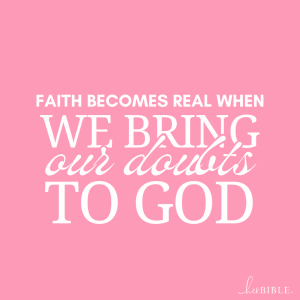
Faith becomes real when we bring our doubts to God and let Him meet us there.
Adapted from This Little Fire of Mine: How Flickers of Doubt Can Spark a Bolder, Brighter Faith by Kendall Mariah. Copyright © 2026 by Kendall Mariah. Used by permission of HarperCollins.
For deeper reflection, listen to John 20 today!
- John 20
Be encouraged today by Kendall on the her STORY Podcast!